Editor’s Note: As of the publication of this article, Architects & Engineers for 9/11 Truth is awaiting a decision from the National Institute of Standards and Technology (NIST) regarding the request for correction that AE911Truth and ten family members of 9/11 victims submitted to NIST on April 15, 2020. The request seeks corrections to eight separate items of information in NIST’s 2008 report on the collapse of World Trade Center Building 7, any of which would effectively force NIST to reverse its conclusion that fires caused the building’s destruction.
NIST informed AE911Truth on June 12, 2020, that it was unable to meet its goal of responding within 60 days. Under the procedure governing such requests, NIST must provide a decision within 120 days of the submission, which would fall on August 13, 2020. If NIST elects not to take the corrective action being sought, AE911Truth and its fellow requesters would then have 30 days to file an appeal with NIST. Should NIST fail in any way to comply with the procedure governing requests or should it fail to rectify the information quality violations documented in the request, AE911Truth and its fellow requesters are prepared to take legal action.
In the meantime, AE911Truth is taking one further step toward correcting the record on the destruction of the Twin Towers with the publication of this article. This exhaustive review of 70 hours of 9/11 news coverage reveals that the hypothesis of explosions bringing down the Twin Towers was not only prevalent among reporters covering the events in New York City on 9/11 but was, in fact, the dominant hypothesis.
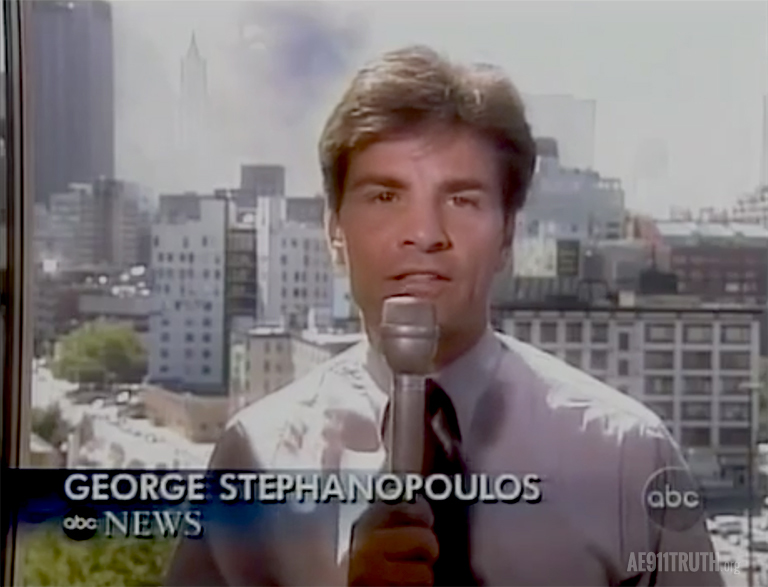
The 36 reporters who brought us the Twin Towers’ explosive demolition on 9/11 include, by network, ABC’s George Stephanopoulos and Cynthia McFadden; CBS’s Harold Dow, Tom Flynn, Mika Brzezinski, and Carol Marin (appearing on WCBS); NBC’s Pat Dawson and Anne Thompson; CNN’s Aaron Brown, Rose Arce, Patty Sabga, and Alan Dodds Frank; Fox News’ David Lee Miller and Rick Leventhal; MSNBC’s Ashleigh Banfield and Rick Sanchez; CNBC’s John Bussey, Ron Insana, and Bob Pisani; WABC’s N.J. Burkett, Michelle Charlesworth, Nina Pineda, Cheryl Fiandaca, and Joe Torres; WCBS’s John Slattery, Marcella Palmer, Vince DeMentri, and Marcia Kramer; WNBC’s Walter Perez; New York 1’s Kristen Shaughnessy, Andrew Siff, John Schiumo, and Andrew Kirtzman; USA Today’s Jack Kelley; and two unidentified reporters (1 and 2) who attended a press conference with Mayor Giuliani and Governor Pataki. Video clips of each reporter’s statements on 9/11 can be viewed below.
The widely held belief that the Twin Towers collapsed as a result of the airplane impacts and the resulting fires is, unbeknownst to most people, a revisionist theory. Among individuals who witnessed the event firsthand, the more prevalent hypothesis was that the Twin Towers had been brought down by massive explosions.
This observation was first made 14 years ago in the article, “118 Witnesses: The Firefighters’ Testimony to Explosions in the Twin Towers.” A review of interviews conducted with 503 members of the New York Fire Department (FDNY) in the weeks and months after 9/11 revealed that 118 of them described witnessing what they interpreted that day to be explosions. Only 10 FDNY members were found describing the destruction in ways supportive of the fire-induced collapse hypothesis.
The interviews of fire marshal John Coyle and firefighter Christopher Fenyo explicitly support this finding. Coyle remarked in his interview, “I thought it was exploding, actually. That’s what I thought for hours afterwards. . . . Everybody I think at that point still thought these things were blown up.” Similarly, Fenyo recalled in his interview, “At that point, a debate began to rage [about whether to continue rescue operations in the other, still-standing tower] because the perception was that the building looked like it had been taken out with charges.”
News reporters constitute another group of individuals who witnessed the event firsthand and whose accounts were publicly documented. While many people have seen a smattering of news clips on the internet in which reporters describe explosions, there has never been, as far as we know, a systematic attempt to collect these news clips and analyze them.
We decided to take on this task for two reasons. First, we wanted to know just how prevalent the explosion hypothesis was among reporters. Second, anticipating that this would be the more prevalent hypothesis, we wanted to determine exactly how it was supplanted by the hypothesis of fire-induced collapse.
In this article, we present our findings related to the first question. In a subsequent article, we will examine how the hypothesis of fire-induced collapse so quickly supplanted the originally dominant explosion hypothesis.